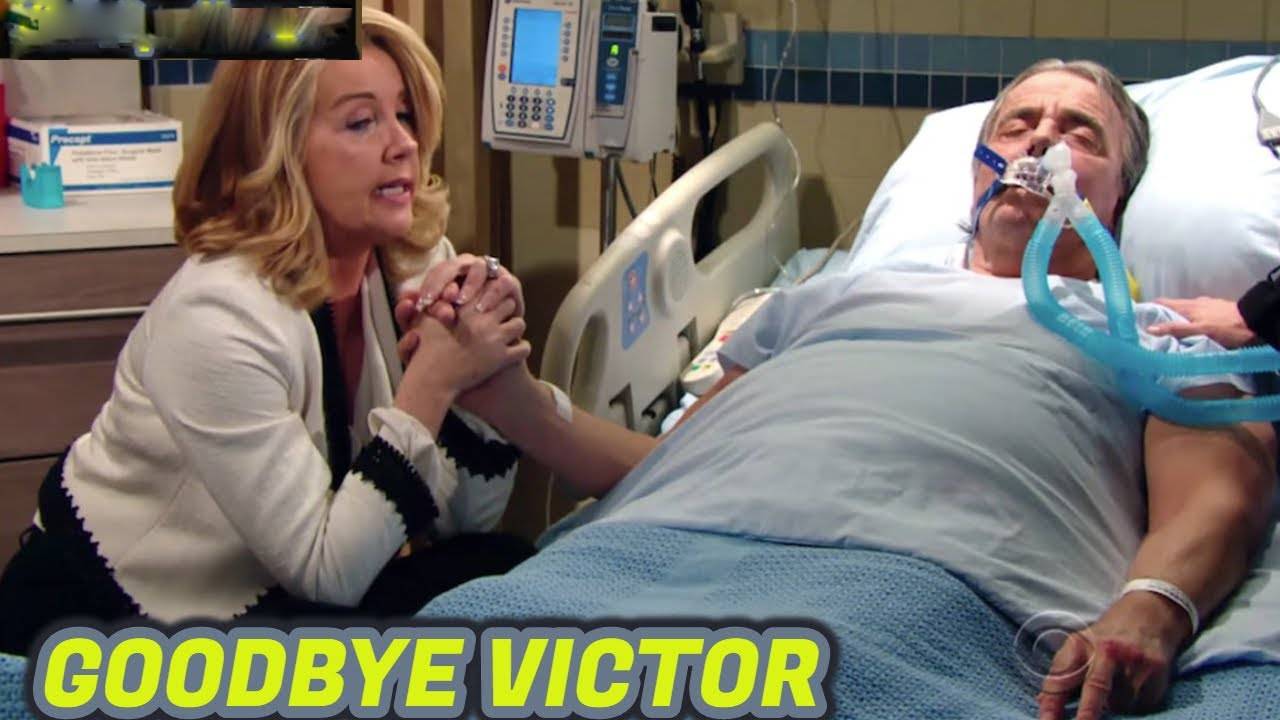
Eric Braeden left Young And The Restless in October after being diagnosed with cancer
Y&R Spoilers Reveal Shocking News While Genoa City has become accustomed to power earthquakes, Victor’s surprise announcement that he may be leaving Y&R in October due to cancer still cuts through every boardroom, living room, and dark corner where deals are signed with smiles and suspicion.
The confession is more than just medical information; it’s a chessboard-shattering move, forcing everyone who has ever faced or relied on Victor to wonder: when the icon retreats, what trajectory will the remaining pieces follow—and who will be brave enough to inherit a legacy built on decades of vision, cunning, and loyalty.
Against this backdrop, the tense battle between Cane and Victor becomes the main drama of the week, where every move—whether a text message, a secret meeting, or a contract signed with almost dry ink—carries the weight of a checkmate in a game of survival chess.
Victor doesn’t just “trap” in the simple sense; he constructs a psychological maze, erecting layers of virtual mirrors that reflect each of his opponent’s weaknesses to force Cane to see his own ambitions and then slip.




From quietly altering the cash flow of a satellite company, to letting controlled leaks of “signals” about a deal that Cane thinks he’s not paying attention to, it’s all part of a masterclass in soft warfare—where victory is achieved without noise but by the opponent’s natural collapse when disoriented.
Cane, of course, is not the type of opponent who can only react. He comes across as someone who has learned by heart the history of Victor’s “bait within a bait” strategy: an attractive project on the surface, a tunnel leading to legal and ethical constraints underneath.
But one of the familiar tragedies of Genoa City is that the smart guy often falls into a trap because he trusts his own intelligence too much. Cane sees the bait, is suspicious of the bait, but is also attracted by the feeling of “outdoing the legend”—a dangerous feeling that can turn every prudent calculation into a smug all-in.
The biggest question is not whether Victor has a trap—of course he does—but whether Cane has the nerve to stop before crossing the invisible line between boldness and recklessness.
The “smart investors” in the story—whether the established shareholders or the players on the sidelines—are betting on the same outcome: Cane will understand why people don’t “trick” the patriarch by making him interested.
Because when Victor is interested, he rarely loses. Against that backdrop, the announcement of Victor’s illness sets off an unpredictable domino effect.

Rivals will smell a “power vacuum” and rush to step in, while allies will struggle with the question of how to protect the legacy: keep the old structure intact or boldly reform before it is destroyed from the outside.
Each part of the empire may face a decision matrix: tighten spending to defend, or expand to attack; stay safe in the zone of influence or risk being pushed into the opponent’s turf.
At the other end of the emotional spectrum is Claire Grace, who announces a dramatic decision to turn her entire life upside down.
For Claire, “turning it upside down” is not simply changing jobs or moving house; it is a reestablishment of identity, a daring to question whether previous choices were based on fear, a need for validation, or an unnamed ideal.
When Claire chooses to sever certain relationships, shift priorities, and step into a new role—be it in an organization, a project, or even a war zone—she understands that every big decision has a price: old friends may see it as a betrayal, old enemies may see it as an opportunity, and she herself must learn to live with the repercussions of her choice when night falls.
Claire’s story explodes not because she defies someone else’s expectations, but because she accepts her own expectations—the invisible mold that often tightens more than any external pressure.
These trajectories intersect at a single point: Victor. The cancer announcement becomes a mirror of all motives.
Nick and Sharon drive for clarity; Claire stands on the precipice of reclaiming her own desire to be proactive; and Cane is teetering on the edge of a cliff where one wrong move could define his reputation for years to come.
If Victor does indeed leave the stage in October, the story will not end; it will change tone. The “psychological mazes” he has built will continue to operate for a while, like the inertia of a well-oiled machine.
But in time, someone will have to make the difficult decisions for him: protect his family by enclosing them in a wall, or opening the gate to let in the wind for renewal; punish the traitors as a lesson, or use them as “leverage” for a bigger deal. Anyone can say they are ready, until they are forced to sign the paper that has real value.